
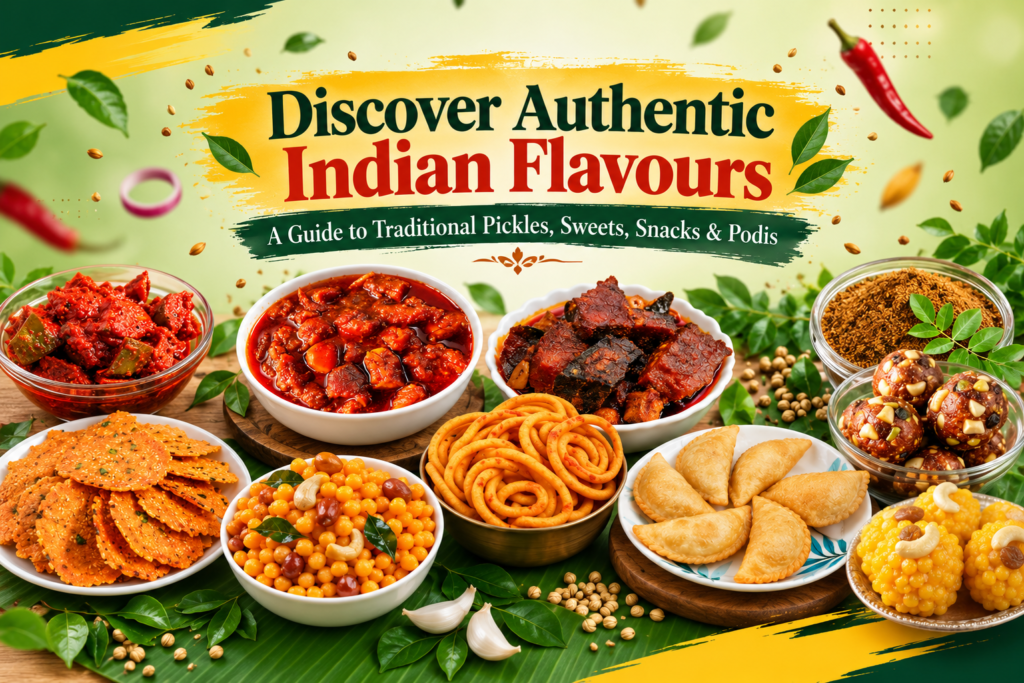
India is home to an incredible variety of food traditions. From regional pickles and aromatic podis to festive sweets and crunchy snacks, traditional Indian foods reflect local ingredients, cooking techniques, family recipes, and cultural traditions.
Among these foods, pickles, sweets, snacks, and podis have a special place in Indian households. They can turn a simple everyday meal into something more flavourful and are often associated with family gatherings, festivals, celebrations, and familiar home-style cooking.
But what makes these foods different from one region to another? How are traditional pickles prepared? What is podi, and how is it commonly served? And what should you consider when choosing and storing these traditional foods?
In this guide, we explore the world of authentic Indian flavours, focusing on traditional pickles, sweets, snacks, and podis while looking at the ingredients, preparation techniques, regional diversity, and storage practices behind them.
What Makes Indian Food So Diverse?
Indian food cannot be described by a single flavour or cooking style. The country’s culinary traditions vary from region to region, with local ingredients, climate, agriculture, culture, festivals, and family traditions influencing the way food is prepared.
The same ingredient may also be used differently in different parts of India.
Mangoes, for example, can be prepared into different types of pickles depending on the regional recipe. Lentils, chillies, sesame seeds, peanuts, garlic, curry leaves, and other ingredients can be roasted, ground, seasoned, and combined in different ways to create distinctive podis.
This regional variety is one of the defining features of Indian food culture. Traditional foods are often shaped by local availability and cooking practices, which is why similar food categories can have very different flavours and textures across India.
Traditional Indian Pickles: Bold Flavours in Every Spoonful
Pickles are an important part of food traditions in many Indian households. They are known for their distinctive combinations of ingredients, spices, salt, oil, sourness, sweetness, or heat, depending on the recipe.
Traditional Indian pickles can be made with fruits, vegetables, herbs, meat, fish, or seafood. Preparation methods vary widely, so there is no single recipe that represents all Indian pickles.
The choice of ingredients and spices plays an important role in the final flavour.
Vegetarian Pickles
Vegetarian pickles can be prepared using fruits, vegetables, herbs, and other plant-based ingredients.
Some familiar varieties include:
- Mango pickle
- Lemon pickle
- Gongura pickle
- Tomato pickle
- Garlic pickle
- Ginger pickle
- Chilli pickle
A mango pickle, for example, can combine raw mango pieces with spices, salt, and oil. Gongura-based preparations are known for the characteristic sour flavour of gongura leaves, while garlic pickles can have a stronger savoury and spicy profile.
The exact flavour depends on the recipe, ingredient proportions, and preparation method.
Non-Vegetarian Pickles
Traditional non-vegetarian pickles are also prepared in some Indian food traditions, particularly in parts of South India.
Chicken, mutton, fish, and prawns can all be used to prepare different varieties. These preparations combine the main ingredient with spices and other recipe-specific ingredients to create a concentrated accompaniment.
Because meat and seafood are perishable ingredients, preparation, handling, cooking, packaging, and storage require appropriate care. For commercially prepared products, customers should always follow the storage and best-before instructions provided by the manufacturer.
How Are Traditional Indian Pickles Prepared?
There is no universal method for making Indian pickles. Different recipes use different ingredients, proportions, preparation techniques, and storage methods.
However, the process commonly involves several stages.
1. Selecting the Ingredients
The main ingredient should be appropriate for the particular pickle recipe. For fruit and vegetable pickles, factors such as freshness, quality, and suitability for the preparation can affect the finished product.
2. Preparing the Ingredients
Ingredients are cleaned and prepared according to the recipe. Cutting, drying, cooking, or other preparation steps may be required depending on the type of pickle.
3. Preparing the Spice Mixture
Spices are measured and combined according to the recipe. Commonly used ingredients can include chillies, mustard, fenugreek, cumin, turmeric, garlic, salt, and other regional ingredients, although the exact combination varies.
4. Combining the Ingredients
The prepared ingredients are combined with the appropriate seasoning, spices, oil, or other recipe-specific components.
5. Developing the Flavour
Some pickle recipes require time for the ingredients and spices to combine and develop their characteristic flavour. The time and method vary according to the recipe.
Good hygiene and appropriate storage are important throughout the preparation and handling process.
Traditional Indian Sweets: Flavours for Celebrations and Everyday Enjoyment
Sweets are an important part of Indian food culture and are commonly associated with festivals, celebrations, family occasions, gifting, and special meals.
Indian sweets are made using a wide range of ingredients, including flour, milk, lentils, nuts, coconut, jaggery, sugar, ghee, and aromatic spices.
Popular varieties include:
- Boondi Laddu
- Nuvvula Laddu
Plain Ariselu
Gavvalu
Dry Fruit Laddu
Palli Nuvula Laddu
Avisa Laddu
Preparation techniques can include roasting, frying, slow cooking, shaping, layering, and preparing sugar or jaggery-based mixtures.
Regional Diversity of Indian Sweets
Indian sweets vary considerably from region to region.
A sweet may have a particular texture, ingredient combination, preparation technique, or traditional occasion associated with its place of origin. Even sweets with similar names can differ in preparation and flavour.
This regional diversity makes exploring Indian sweets an interesting way to discover different culinary traditions.
Traditional Indian Snacks: Crunchy, Savoury and Full of Variety
Indian snacks come in many forms, from everyday tea-time favourites to foods prepared especially for festivals and family occasions.
Many traditional savoury snacks use ingredients such as rice flour, gram flour, lentils, peanuts, sesame seeds, spices, and other regional ingredients.
Some familiar examples include:
- Kara Boondi
Karapusa
Mixture
Murukulu
Chekodi
Sakinalu
Garelu
Nuvvula Chekodi
Jonna Karapusa
Minapa Karapusa
What Makes Traditional Snacks Special?
The final texture of a traditional snack often depends on more than the ingredients alone.
The consistency of the dough or batter, ingredient proportions, shaping technique, frying or cooking method, and temperature can all influence the finished texture.
For example, a crunchy snack requires appropriate preparation and cooking to achieve the intended texture. Small differences in technique can produce noticeably different results.
These preparation details are often part of regional and family cooking practices.
What Is Podi? Understanding a Traditional Indian Spice Powder
Podi is a dry, ground seasoning commonly associated with South Indian cuisine.
Depending on the recipe, podi can be prepared using ingredients such as roasted lentils, chillies, spices, sesame seeds, peanuts, garlic, curry leaves, or other ingredients.
Popular varieties include:
- Curry Leaves Podi
Kandi Podi
Munugaku Podi
Vellulli Podi
Nuvvula Podi
Kothimeera Podi
Avisela Karam
Podi is commonly served with foods such as rice, idli, and dosa. It may be mixed with rice and ghee or oil or served separately as an accompaniment, depending on the variety and personal preference.
What Determines the Flavour of Podi?
The flavour and texture of podi can be influenced by:
- The ingredients used
- Ingredient proportions
- Roasting time
- Roasting temperature
- Spice levels
- Grinding consistency
- Salt and seasoning
Roasting is particularly important in many podi preparations because it contributes to the aroma and flavour of the finished powder.
Different recipes can therefore produce noticeably different podis, even when they use some of the same ingredients.
The Importance of Ingredients in Traditional Indian Foods
Ingredients are at the heart of traditional food preparation.
For pickles, the selection and preparation of ingredients such as raw mangoes, lemons, chillies, vegetables, or other main ingredients can influence the final flavour and texture.
For sweets and snacks, ingredients such as flour, lentils, nuts, coconut, jaggery, sugar, ghee, and spices each contribute different characteristics to the finished food.
For podis, the quality and preparation of lentils, spices, seeds, nuts, herbs, and other ingredients can influence aroma, flavour, and texture.
Traditional preparation is not simply about using many ingredients. It is also about selecting suitable ingredients, using appropriate proportions, and paying attention to preparation techniques.
How Regional Food Traditions Shape Indian Flavours
India’s traditional foods reflect the diversity of the country.
Different communities and regions have developed their own ways of preparing pickles, sweets, snacks, podis, spice mixtures, and other foods.
South Indian food traditions, for example, include a wide range of podis, pickles, savoury snacks, and rice accompaniments. Other parts of India have their own distinctive approaches to pickling, sweets, snacks, and spice blends.
Even within the same broad category, ingredients and preparation methods can change from one region to another.
This means that exploring traditional Indian food is also a way of discovering the cultural and culinary diversity of different parts of the country.
Homemade Food and Traditional Preparation
For many Indian families, traditional food is closely connected with home kitchens and familiar recipes.
A recipe may contain only a few main ingredients, but the preparation process can involve several details that influence the final result.
These may include:
- Choosing suitable ingredients
- Measuring ingredients carefully
- Preparing spices correctly
- Roasting ingredients to the appropriate level
- Following the correct cooking sequence
- Maintaining clean preparation practices
- Using suitable packaging and storage methods
For a food business, maintaining consistency while preparing traditional products at scale requires attention to ingredients, preparation, hygiene, packaging, and storage.
These practical details are an important part of producing food that customers can enjoy consistently.
Discover Traditional Flavours with Marvin Ruchulu
Marvin Ruchulu is a food brand from Telangana offering a range of traditional food products, including vegetarian pickles, non-vegetarian pickles, sweets, snacks, and podis.
Our focus is on bringing familiar Indian flavours together in a range that can be enjoyed by food lovers beyond a single region.
Our product range includes traditional-style options such as pickles, podis, savoury snacks, and sweets. Each category has its own ingredients, preparation methods, flavour profile, and serving traditions.
Whether you are looking for a pickle to accompany a meal, podi for rice or breakfast dishes, a savoury snack for tea time, or a traditional sweet for a special occasion, you can explore the products available from Marvin Ruchulu.
Visit MarvinRuchulu.com to explore our range of traditional pickles, podis, snacks, and sweets.
Conclusion
Indian food traditions are shaped by variety, regional ingredients, family recipes, and preparation techniques. Traditional pickles, sweets, snacks, and podis each offer a different way to experience the flavours and food traditions found across the country.
From tangy pickles and aromatic podis to festive sweets and crunchy savoury snacks, these foods continue to have a place in everyday meals and special occasions.
Exploring traditional Indian foods is not about finding one single definition of authenticity. It is about understanding the ingredients, techniques, regional differences, and traditions that give each food its identity.
At Marvin Ruchulu, we celebrate this diversity through our range of vegetarian pickles, non-vegetarian pickles, sweets, snacks, and podis.
Explore the range and discover traditional flavours at MarvinRuchulu.com.